
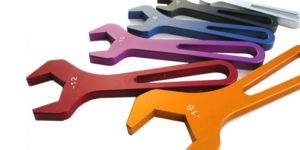
 We may be best known for silicone hoses but our online shop is full of useful products to help you the car builder. We have a range of very handy tools to help you with making your intercooler pipes, coolant or intake systems such as Tube roll beading tools, or pipe flaring tools or tube straighteners for your aluminium hard lines. As with all our products these tools are very well made from quality materials and built to last.
Our range includes:
AN Wrenches
Anodised colour coded wrenches sized to fit the swivel nuts on hose ends. These wrenches have a fully rounded edge to fit your hand. Machined from heat treated 2024 aluminium.
Hose end fitting tool
This tool is a god send when it comes to assembling and crimping AN hose end fittings. Does a great job with ease in minutes! Supplied with a number of dies / sockets to crimp and assemble braided fuel and oil lines. Ideal for the workshop or engine builder.
Tube Straightening tool
Vice mounted billet aluminium construction designed to heavy duty and years of service, our tube straightener will easily straighten all your fuel system hard lines and brake lines. Suitable for copper or aluminium tubing.
Tube Flaring Tool
We also do a heavy duty professional tube flare devise, designed to flare tubes to a 45° flare to apply suitable fuel hose fittings onto the tube / hard pipe.
 A recent survey conducted by Halfords Autocentres of 20,000 motorists found that almost a third of motorists (32 per cent) believed that kicking tyres is an adequate test to see if they are properly inflated or not. What is more concerning is that almost two-in-five motorists (40%) have no idea what the minimum legal tyre tread depth is.
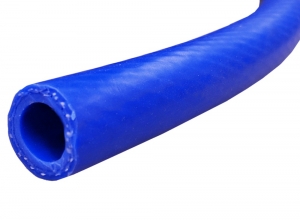 Our new selection of Silicone Radiator and coolant Hoses are a popular alternative to the standard rubber hose that typically connect the various parts of the radiator to other systems in a car. This hose is best suited for low pressure application. They come in internal diameters of 16mm (5/8”) and 19mm (3/4”).
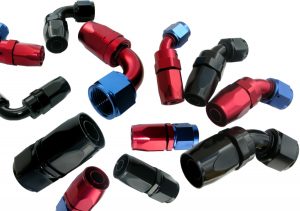 Here at Viper Performance, we supply and manufacture Hose Fittings to the highest quality, in order to full our clients needs. Our AN / JIC Fuel and Oil hose end fittings are beautifully made anodised in traditional Red/Blue or available in Piano BLACK hand polished.
 So what if you are not based in the UK but you’ve heard about our great quality hoses? Well, we offer worldwide delivery!
 Last year we wrote a post about
  The basics of the combustion engine remain the same regardless of the size of vehicle the engine is powering. If you have an engine you will need a hose. The only difference is that it be scaled up to fulfil the needs of larger vehicles.
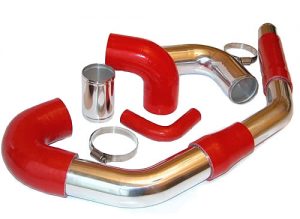 Our aluminium hose joiners are ideal for joining hoses for a variety of applications including coolants, air intake systems, intercooler systems or superchargers. They can also be used for custom fabrications to ensure the hoses are bespoke to the needs of your project. The aluminium hose joiners are designed to fit perfectly with any universal silicone hose.
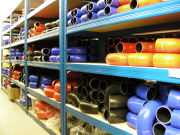 There are great benefits to becoming a dealer of Viper Performance products. Excellent dealer margins are available as well as competitive retail prices. We discuss all trade discounts on an individual basis and these discounts will vary depending on order patterns and your account history with us here at Viper Performance.