
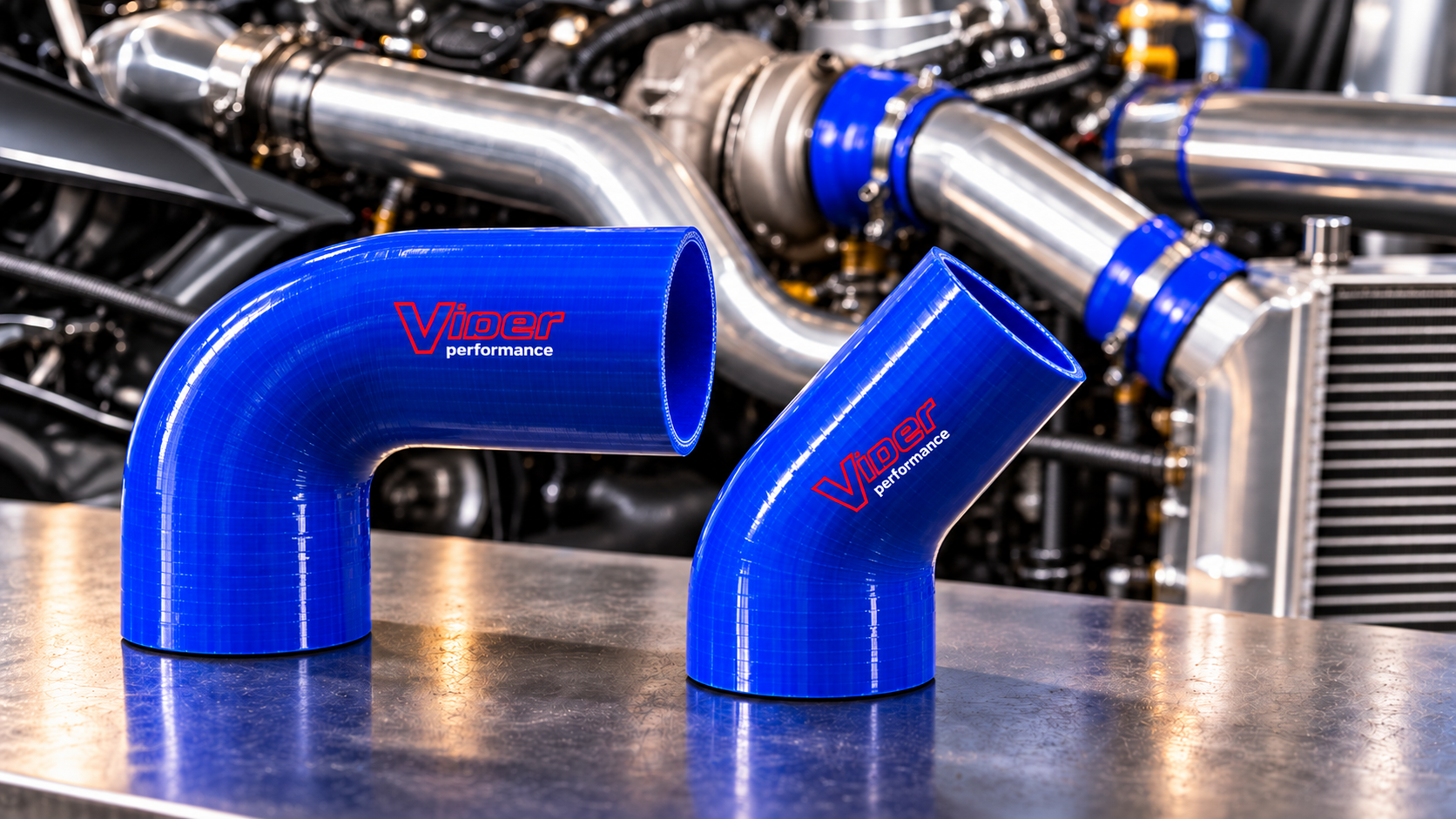
Anyone who has installed custom cooling or intake pipework knows that a layout that looks simple on paper can be surprisingly awkward in practice. The pipe ends are in the wrong place, a bracket blocks the bend or an extra joiner makes the assembly more complicated than necessary. An unequal leg silicone elbow is a straightforward component that can solve several of these problems.
1. One side of the bend needs to be much longer
A conventional elbow often has legs of similar length. But real installations are rarely symmetrical. You might need a 90-degree turn followed by a longer straight run to the next component. An unequal leg elbow provides additional hose length on one side, potentially removing the need for a separate straight connector and rigid joiner.
2. There are too many connections
Every extra join introduces another clamp and sealing surface to assemble and inspect. Correctly installed joints can be reliable, but eliminating unnecessary ones can simplify maintenance. A suitable long-leg elbow may replace an elbow, a straight hose and a joining piece. The result can be a tidier installation with fewer potential leak points, provided the hose is correctly supported.
3. The engine bay is crowded
Radiators, intercoolers, brackets, wiring and other components compete for space. A 45° unequal leg silicone elbow can help create a moderate change of direction, while a 90° unequal leg silicone elbow provides a right-angle turn. The longer leg may allow the next connection to be positioned away from a particularly congested area.
4. You need to trim a hose to the final length
Custom installations do not always match catalogue dimensions. Where the design permits, an extended straight leg can be measured and trimmed to fit. Allow for sufficient insertion depth under the clamp and avoid cutting into the curved or reinforced transition area. Measure twice before cutting: removing material is much easier than putting it back.
5. The existing route has become unnecessarily complicated
A vehicle that has gained a new radiator, intercooler or engine configuration may have acquired several additional joiners and short hose sections. Reviewing the route with a longer unequal leg elbow in mind may help simplify the assembly. It will not automatically add horsepower or improve flow, but it can reduce clutter and make inspections easier.
Choosing between 45° and 90°
Choose the bend angle that matches the route, then confirm internal diameter, leg lengths, pressure, temperature and media compatibility. A 45-degree elbow suits a gentler turn; a 90-degree elbow suits a right-angle connection. Neither should be forced into a different shape just to make it fit.
Find a better fit
Viper Performance offers 45° unequal leg silicone elbows and 90° unequal leg silicone elbows for suitable custom pipework applications. Compare the dimensions and specifications before choosing the best layout for your project.